
Careers & Training
Security Guard vs. Security Officer: What's the Difference?
The titles are used interchangeably, but the roles are not the same. Training, authority, equipment, supervision, reporting, and pay all separate a Security Officer from a Security Guard.
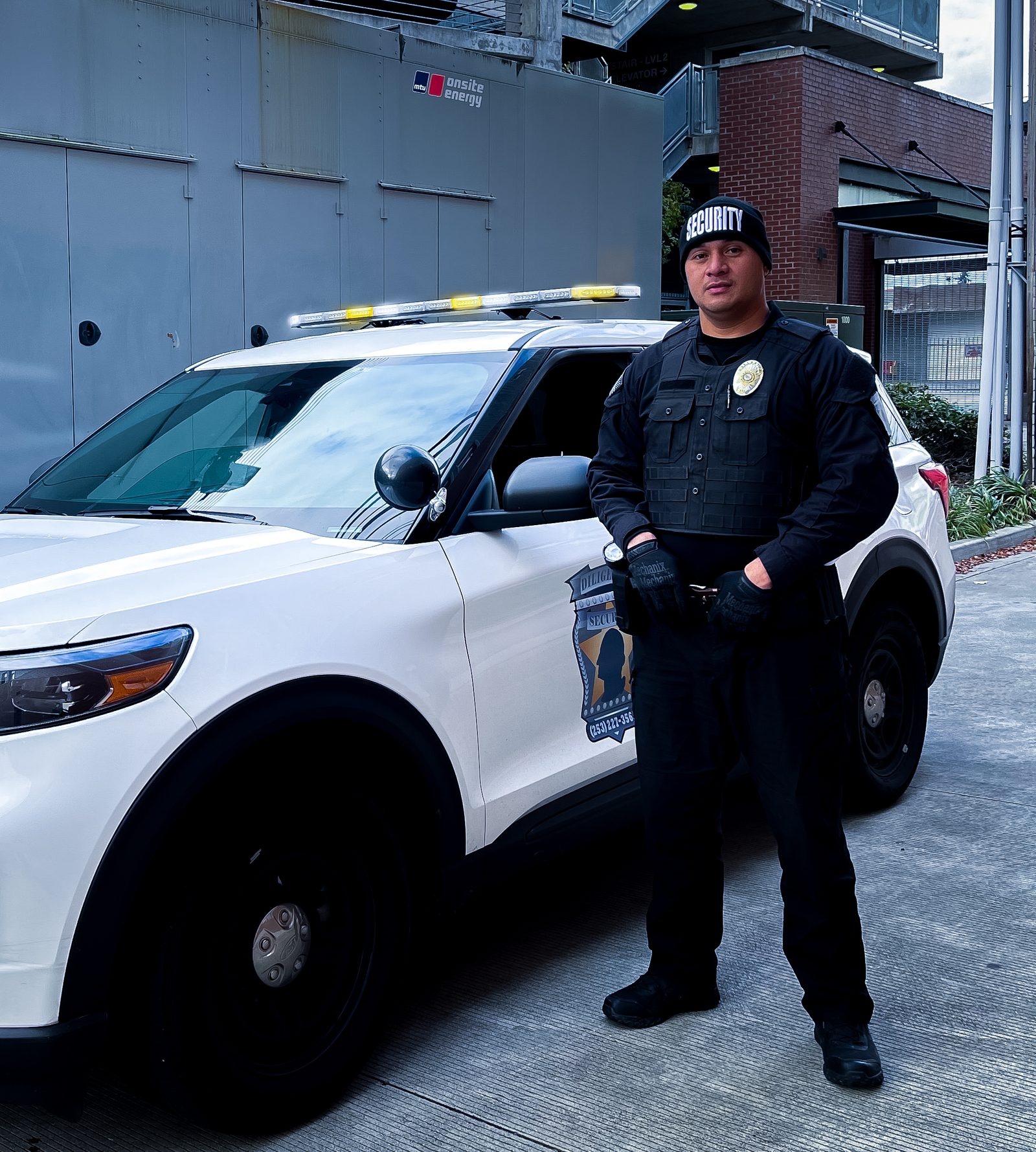
In Washington, the license says "Security Guard" — that is the statutory term, and legally the two words cover the same license class. But inside the industry the titles mean very different things, and Clients who assume they are synonyms are the ones most often disappointed by what shows up on their property. The difference is not vocabulary. It is how much training, structure, and accountability sits behind the person in the uniform.
The short version
A Guard occupies a place. An Officer is responsible for a property. One is measured by presence; the other is measured by observation, communication, documentation, and outcomes.
1. Depth of training
This is the biggest gap. Washington's legal minimum is eight hours of pre-assignment training, plus eight hours of post-assignment and four hours of annual refresher training. A Guard is often exactly that: the minimum. An Officer is developed past it. Ours complete OIP 1 before working independently and OIP 2 after probation — 13 days total before role-specific tracks, 14 with Supervisor development. Proven Officers continue into OIP 3, advanced Security Officer training, which is where behavioral psychology, personality typing, and crisis intervention are taught.
2. Understanding of legal authority
Neither role carries police powers. The difference is whether the person knows that precisely. An Officer is trained in Washington licensing and citizen-detainment law and the legal limits of force, so they know exactly where their authority ends. A Guard who has never been taught those limits is the single largest liability exposure on a property — over-stepping is far more expensive than under-reacting.
3. De-escalation as a primary skill
An Officer works a structured escalation model — ours is a five-level Escalation of Force Continuum built around verbal de-escalation — and treats resolving a situation without contact as the successful outcome. A minimally trained Guard tends to have two settings: ignore it, or confront it. Our de-escalation training for Security Guards and Officers in Washington is taught in OIP 3, and is open to partner security companies.
4. Documentation and reporting
A Guard signs a sheet. An Officer produces a timestamped, photo-supported, customer-facing record of what was checked, when, and what was found. Reports are what prove coverage, support insurance and legal positions, and reveal patterns before they become losses — for Fire Watch in particular, the log is the compliance deliverable.
5. Supervision and accountability
Officers work under named Supervisors who conduct unannounced field checks during live shifts and adjust Site Instructions as a site reveals itself. Guards are frequently unsupervised between shifts, which is how "coverage" quietly becomes a parked vehicle.
6. Uniform and professional appearance
Deterrence is visual. A pressed, clearly marked uniform, visible identification, and a marked patrol vehicle tell an opportunist that a property is actively managed. A generic polo tells them the opposite. Appearance standards are a real operational control, not vanity.
7. Equipment and capability
An Officer carries the tools the job actually requires and is certified in each: duty belt, handcuffs and pepper spray after probation, radios, lighting, reporting technology, and — for Patrol Officers — fleet access after extensive drivers training. Equipment without certification is a hazard; certification is what separates the two.
8. Experience and career structure
"Guard" is often an entry-level job people pass through. "Officer" implies a ladder: probation, advanced training, Field Training Officer, Supervisor, Field Manager, and beyond. That structure is why Officers accumulate experience instead of turning over, and turnover is what erodes a security program — a new face every month never learns what normal looks like on your site.
9. Pay, benefits, and retention
Better-trained Officers are paid more, are more likely to have real benefits and paid time off, and stay longer. That is not a soft benefit for the Client — it is the mechanism that produces consistency, familiarity with the property, and Officers who care whether your site is secure.
10. Site Instructions and site knowledge
An Officer works from written Site Instructions: the specific checks, route, intervals, sensitive areas, and escalation contacts for that property. A Guard often works from a verbal instruction to "keep an eye on things." Written orders are what make performance measurable.
11. Judgment under pressure
Medical emergencies, fire alarm failures, trespass, domestic disputes, and after-hours emergencies demand decisions in seconds. An Officer has rehearsed emergency response, medical basics, and Fire Watch fundamentals. A Guard improvises.
12. Communication with Clients and responders
Officers are trained to brief a property manager, hand off cleanly to police or fire, and communicate calmly with tenants, staff, and the public. On most sites the Officer is the most visible representative of the Client's brand after hours.
What this means when you hire
Do not ask a company which title they use — ask what sits behind it. How many hours of training beyond the state minimum? Who supervises the shift, and how is that verified? What does a report look like, and how fast do I get it? Who answers the phone at 3 a.m.? What is your annual turnover? Those answers tell you what you are actually buying.
Diligence Security staffs Officers, not bodies, across the Puget Sound — for On-site posts, Mobile Patrol, Emergency Fire Watch, and Event Security.
Frequently Asked Questions
Is a Security Officer the same as a Security Guard?
Legally in Washington they hold the same license class — the statute uses the term 'Security Guard.' In practice the titles signal different levels of training, supervision, equipment certification, documentation standards, and experience, with Security Officer indicating the higher standard.
Do Security Officers have more authority than Security Guards?
No. Neither has police powers, and both operate under the same Washington law. The difference is that a properly trained Officer knows exactly where that authority ends — including detainment law and the legal limits of force — which reduces liability for the Client.
Why do Security Officers cost more per hour?
Because you are paying for training days beyond the state minimum, active Supervisor oversight, certified equipment, real reporting, and lower turnover. Those factors are what prevent incidents rather than simply record them.
Are Diligence Security Officers armed?
No. We are an unarmed agency. Our Officers carry a duty belt with handcuffs and pepper spray after completing probation and the associated certification, and rely on presence, communication, and de-escalation.
Which does my property need?
If documentation, liability reduction, compliance, or consistent coverage matters — which is nearly every commercial, industrial, residential, and construction site — you need an Officer standard. Contact us to discuss the level of coverage the property requires.
Talk to a local security Team
Diligence Security protects commercial, industrial, and residential properties across the Puget Sound. Explore our Security services — from Mobile Patrols to Emergency Fire Watch — or see the Areas we serve. Ready to talk? Contact us for a site evaluation.